

Contents
- How does GOWA assess Türkiye’s offshore wind potential and its prospective role in the global offshore wind market?
- What are the most important steps Türkiye should prioritise to establish a bankable, transparent and internationally competitive offshore wind market?
- From a global investor perspective, what regulatory, financial and technical conditions will be essential for attracting international developers and supply-chain companies to Türkiye’s first offshore wind projects?
- Türkiye has set an offshore wind capacity target of 5 GW by 2035. How realistic is this target, and what needs to happen in the short term for it to be achieved?
- How could Türkiye benefit from international cooperation and GOWA’s global network as it develops its offshore wind ecosystem?
Amisha Patel, Executive Director of the Global Offshore Wind Alliance, says Türkiye’s estimated 75 GW offshore wind potential, established manufacturing base, skilled workforce and strategic location could position the country as a regional clean energy and manufacturing hub. According to Patel, Türkiye’s 5 GW offshore wind target for 2035 is ambitious but achievable if the right enabling conditions are put in place.
As Türkiye prepares to launch its first offshore wind tender, the country is entering a decisive phase in the development of its offshore wind market. Establishing a predictable investment framework, coordinating grid and port infrastructure, strengthening domestic supply chains and drawing on international experience will be critical to turning Türkiye’s offshore wind ambitions into commercially viable projects.
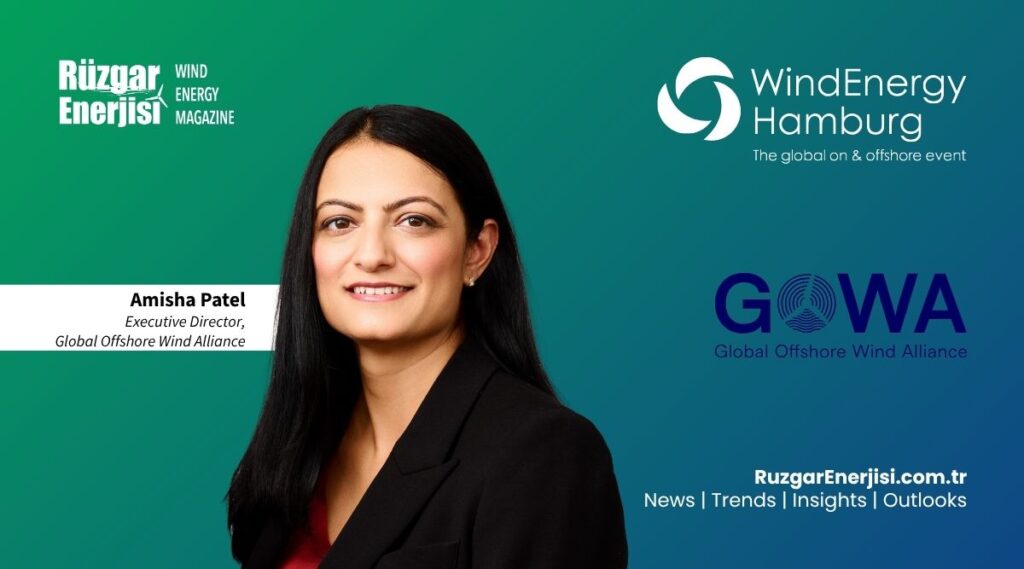
In this special interview for Rüzgar Enerjisi Magazine’s WindEnergy Hamburg edition, Amisha Patel, Executive Director of the Global Offshore Wind Alliance (GOWA), discusses Türkiye’s offshore wind potential, investor expectations, the country’s 2035 capacity target and the role that international cooperation could play in developing a competitive offshore wind ecosystem.
How does GOWA assess Türkiye’s offshore wind potential and its prospective role in the global offshore wind market?
Türkiye is entering offshore wind at an important moment for the global industry. Around the world, offshore wind has evolved from a handful of pioneering projects in Northern Europe into a truly global industry. According to the Global Wind Energy Council’s latest market intelligence, more than 92 GW of cumulative offshore wind capacity is now installed worldwide, over 50 GW is under construction, and the sector is expected to add more than 327 GW of new capacity over the next decade.
While Türkiye’s offshore wind market is still in its early stages, the country has many of the characteristics needed for long-term success, including strong natural resources, industrial capabilities, political commitment and an offshore wind roadmap already in place. With plans to launch its first offshore wind tender by the end of 2026 and install its first turbines by 2030-2031, the next few years will be decisive in determining whether Türkiye can successfully transition to a competitive offshore wind industry capable of supporting energy security, economic growth and regional clean energy leadership.
Türkiye has an estimated 75 GW of offshore wind potential, including substantial floating offshore resources. Combined with rapidly growing electricity demand, an established wind manufacturing industry, strong maritime capabilities and major coastal demand centres, Türkiye is well-positioned to become part of the next phase of offshore wind growth.
Offshore wind represents more than a new source of renewable electricity for Türkiye. It is an opportunity to strengthen energy security, reduce dependence on imported fossil fuels, support domestic industry, and position Türkiye as a regional clean energy and manufacturing hub.
These benefits also extend beyond Türkiye’s borders. A successful offshore wind industry would establish offshore wind in a region where commercial deployment is still limited, creating opportunities for greater collaboration across the Mediterranean on infrastructure, supply chains and knowledge sharing.
Türkiye’s progress will also be watched closely by many emerging markets seeking practical pathways to decarbonisation. The transition to offshore wind provides an important example for other emerging economies. It demonstrates that offshore wind is no longer limited to traditional European markets, helping build confidence amongst governments, investors and development finance institutions.
Türkiye’s established manufacturing base, skilled workforce, strategic location between Europe and Asia and strengths in the wind, shipbuilding and maritime industries also position it to become an important supplier to regional offshore wind markets. In addition, its significant floating offshore wind potential could help accelerate the commercialisation of floating offshore wind by expanding the global pipeline of projects and supporting further cost reductions.
When considered together, these factors put Türkiye in a strong position to accelerate its own energy transition while also supporting the global offshore wind industry. As a new market, Türkiye can help diversify the sector’s growth, strengthen supply chains and advance regional collaboration in the Mediterranean.
As COP31 President, Türkiye also has a unique opportunity to demonstrate global leadership by integrating offshore wind into efforts to deliver the global electrification target while advancing broader climate, energy and economic goals.
What are the most important steps Türkiye should prioritise to establish a bankable, transparent and internationally competitive offshore wind market?

Türkiye has made significant progress in establishing the foundations for an offshore wind market, including the development of a clear roadmap and auction framework, and the identification of suitable development zones. These are important first steps towards creating a competitive market capable of attracting experienced international and domestic developers.
Looking ahead, one of the key priorities should be providing long-term policy and revenue certainty. Offshore wind projects are highly capital-intensive, with asset lifetimes typically exceeding 25 years. Investors and lenders therefore require confidence that projects will generate stable and predictable revenues over the long term. International experience has consistently shown that transparent market frameworks and predictable revenue mechanisms can help reduce financing costs and improve the bankability of projects.
Alongside revenue certainty, maintaining a transparent, predictable and competitive auction process, supported by clear permitting pathways, grid planning and long-term deployment signals, will be important to build investor confidence. Early engagement with industry and financial institutions can also help ensure that auction design reflects market realities while encouraging strong competition.
Ultimately, establishing a bankable offshore wind market is about creating a stable investment environment that balances government objectives with investor confidence. Drawing on international best practice, while tailoring solutions to Türkiye’s national context, will help position the country as a competitive offshore wind market and support the successful delivery of its long-term clean energy ambitions.
From a global investor perspective, what regulatory, financial and technical conditions will be essential for attracting international developers and supply-chain companies to Türkiye’s first offshore wind projects?
As a diplomatic-led, multi-stakeholder alliance, GOWA does not advocate for specific national policy choices. Rather, we work with governments, industry and international partners to share global experience and lessons learned from offshore wind markets at different stages of development.
From a global investor perspective, one of the most important considerations is market predictability. Offshore wind requires significant upfront investment in project development, transmission infrastructure, ports and supply chains. Developers, manufacturers and financiers therefore need confidence that projects will move from ambition to delivery.
That begins with a clear and transparent regulatory framework, efficient and predictable permitting processes, and visibility of a long-term project pipeline. Investors will also look for clarity around environmental approvals, grid connection arrangements and project development timelines, as these factors play an important role in reducing project risk. Stable market frameworks that provide confidence in future investment opportunities are also essential to attracting experienced international developers and encouraging supply-chain companies to establish a local presence.
Equally important is coordinated planning for enabling infrastructure. Large-scale offshore wind deployment depends not only on the projects themselves, but also on timely investment in transmission systems, substations, ports and logistics. Planning these investments early helps avoid bottlenecks, reduces delivery risks and provides greater confidence for investors making long-term decisions. Close collaboration between government, industry and stakeholders across the offshore wind value chain is critical ensure infrastructure, supply chains and workforce development progress in step with project delivery.
International experience demonstrates the importance of policy certainty. Countries that have successfully established offshore wind industries have generally provided clear long-term direction, enabling companies to invest confidently in manufacturing facilities, vessels, workforce development and wider supply chains. Reducing regulatory and market uncertainty ultimately lowers investment risk and can help improve access to competitive financing.
Finally, successful offshore wind development depends on more than technical and financial conditions alone. Early and meaningful engagement with coastal communities, fisheries and other ocean users helps build public confidence, reduces project risk and supports more durable outcomes over the lifetime of projects.
Türkiye has already established many of the foundations for offshore wind development. The opportunity now is to focus on implementation by maintaining transparent and predictable market conditions, coordinating infrastructure development, and drawing on international cooperation and global best practice to overcome common challenges and accelerate delivery.
Türkiye has set an offshore wind capacity target of 5 GW by 2035. How realistic is this target, and what needs to happen in the short term for it to be achieved?

The target is ambitious but achievable if the right enabling conditions are put in place.
As mentioned, Türkiye is not starting from scratch. The country has built a successful onshore wind industry over the past two decades, developed strong manufacturing capabilities and possesses considerable offshore wind resources.
The next few years will be decisive.
Planning for transmission infrastructure and ports needs to begin early to avoid future bottlenecks. This needs to be developed alongside the implementation of clear regulatory frameworks, competitive auction mechanisms and streamlined permitting processes, to reduce project risk and attract investment. At the same time, maintaining a visible long-term project pipeline will give manufacturers confidence to expand domestic production and strengthen local supply chains.
One of the greatest advantages for emerging markets today is that they can build on decades of experience from countries that have already faced many of the same challenges. Lessons from mature markets can help governments avoid common pitfalls, accelerate deployment and reduce investment risk.
If these foundations are established, and by learning from mature markets, Türkiye could position itself to deliver on its 2035 target while creating jobs, strengthening energy security and supporting long-term industrial growth.
How could Türkiye benefit from international cooperation and GOWA’s global network as it develops its offshore wind ecosystem?
GOWA is a government-led, multi-stakeholder alliance co-founded by the Government of Denmark, the International Renewable Energy Agency (IRENA) and the Global Wind Energy Council (GWEC). We bring together governments, industry, international organisations and civil society to accelerate offshore wind deployment through knowledge sharing, policy dialogue and international cooperation.
International cooperation is essential to build competitive, secure and resilient offshore wind industries.
The sector has built a substantial body of knowledge covering everything from market design and financing structures to supply-chain development, marine planning and stakeholder engagement. For Türkiye, drawing on this global body of knowledge can help inform national decision-making, reduce risk and accelerate market development.
Regional collaboration is also an important part of this. As offshore wind expands into new regions, collaboration between neighbouring countries facing similar opportunities and challenges can help reduce costs, strengthen supply chains, avoid common pitfalls and accelerate market growth.
This is where GOWA plays an important role. One of the most valuable aspects of our work is creating opportunities for governments to learn directly from one another. We connect stakeholders across regions to share lessons, exchange practical experience and identify opportunities for collaboration. We are already supporting regional cooperation initiatives in the Asia-Pacific, and we see significant potential to strengthen similar collaboration in other regions, including around the Mediterranean.
GOWA’s role is not to prescribe a single model for development. Every country has different resources, industrial strengths, governance systems and social contexts. Instead, we help governments learn from one another, adapt international experience to local circumstances and access practical tools that support decision-making.

Author
Mesut Kul



 Rüzgar Enerjisi (Wind Energy)Wind Energy Turkey · Ekim 2026 · Özel EkRead the latest issue free →