



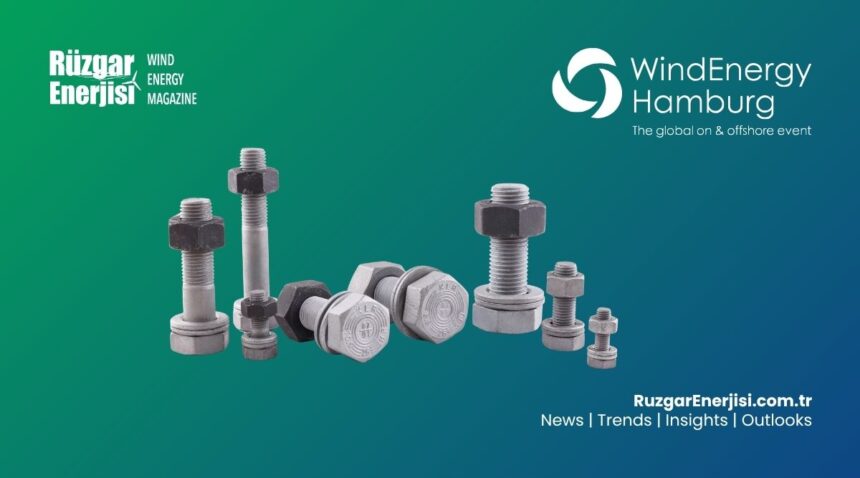
Modern wind turbines place demanding mechanical and environmental requirements on structural connections. Kaleliler Fasteners develops high-strength bolting systems for wind energy applications, combining controlled manufacturing, surface protection, preload performance, testing and traceability.

- By Kaleliler Fasteners Engineering Team
- 1. Automated hot forging and surface protection
- 2. Preloaded and non-preloaded structural bolting
- 3. Preload control with factory-lubricated bolting sets
- 4. In-house testing and full traceability
- 5. Carbon data and evolving European supply-chain requirements
- Fastening systems as part of turbine reliability
- About Kaleliler Fasteners
By Kaleliler Fasteners Engineering Team
From onshore turbines exposed to variable wind loads to offshore installations operating in corrosive marine environments, structural connections are expected to perform under repeated loading, vibration and long fatigue cycles. Tower flanges, nacelle structures, foundation interfaces and auxiliary steelwork therefore require fastening systems with consistent mechanical properties, controlled surface conditions and reliable documentation throughout the supply chain.
1. Automated hot forging and surface protection
The performance of a structural bolt begins with the forming process. Kaleliler operates automated robotic hot-forging lines for large-diameter structural bolts up to M48. Controlled induction heating and repeatable forming parameters are used to support consistent grain flow, dimensional stability and mechanical performance in components intended for demanding structural applications.
Surface protection is equally important in wind energy projects, particularly where components are exposed to humidity, salt, temperature variation and long service intervals. Kaleliler uses automated hot-dip galvanizing processes for applicable product groups. Controlled process parameters are intended to provide consistent zinc coating while maintaining the dimensional requirements of the fastening system and its threads.
2. Preloaded and non-preloaded structural bolting
Wind turbine structures include both critical preloaded joints and secondary structural connections. Kaleliler’s product portfolio includes CE-marked structural bolting assemblies for applications covered by the EN 14399 and EN 15048 series, subject to the applicable product configuration and declaration of performance.
Preloaded structural bolting assemblies are used where controlled clamping force and resistance to slip or fatigue are central to the joint design. In wind energy projects, these applications can include tower section flanges, foundation-related interfaces and other dynamically loaded steel connections. Non-preloaded assemblies are used in appropriate secondary steel structures, auxiliary frames and infrastructure where the joint design does not require a specified preload.
3. Preload control with factory-lubricated bolting sets
Achieving the required preload during installation depends not only on bolt strength but also on the friction conditions of the complete assembly. This becomes particularly important for galvanized fasteners, where uncontrolled friction can affect the relationship between applied torque and resulting clamping force.
For applications requiring defined tightening behaviour, Kaleliler supplies factory-lubricated bolting sets with controlled k-class performance in accordance with the relevant EN 14399 requirements. Depending on the declared product configuration, K1 or K2 performance classes can be used to support repeatable tightening and preload control. K2 represents tighter control of torque coefficient variation than K1 and is therefore relevant where greater precision in torque-to-preload behaviour is required.
| K-class | Characteristic | Application value |
|---|---|---|
| K1 | Controlled k-factor range | Suitable for specified preloading procedures where repeatable torque-to-preload behaviour is required. |
| K2 | Tighter control of k-factor scatter | Supports applications where more precise preload control and lower variation are required. |
4. In-house testing and full traceability
As wind turbine platforms increase in size, fastening systems are required to demonstrate predictable performance under higher loads and more demanding installation conditions. Kaleliler’s quality-control infrastructure supports mechanical, impact and torque/preload testing for large-diameter fastening systems, with project-specific test documentation available according to product and customer requirements.
• Torque and preload testing: verification of torque-tension behaviour and clamping performance for applicable bolting assemblies.
• Mechanical and impact testing: tensile strength, proof load, hardness and Charpy V-notch impact testing, including low-temperature requirements where specified.
• Traceability and documentation: delivery batches can be traced to raw-material heat or cast information, supported by EN 10204 3.1 material certificates and applicable CE Declarations of Performance (DoP).
5. Carbon data and evolving European supply-chain requirements
Environmental reporting is becoming a more visible part of European industrial supply chains. For iron and steel products that fall within the applicable scope of the EU Carbon Border Adjustment Mechanism (CBAM), importers increasingly require reliable information on embedded emissions and production-related carbon data.
Kaleliler states that it tracks and reports carbon-related production data to support customer documentation where applicable. The company combines automated manufacturing, controlled heat-treatment processes and raw-material traceability with project-specific reporting requirements. For wind energy OEMs, EPC contractors and component suppliers, this creates a clearer link between mechanical product documentation and the environmental data increasingly requested in European procurement processes.
Fastening systems as part of turbine reliability
Fasteners represent a comparatively small share of a wind turbine’s overall component count and investment value, yet they perform a critical structural function. As turbine sizes, hub heights and offshore deployment continue to increase, the requirements placed on bolted connections are becoming more demanding. Manufacturing consistency, controlled preload behaviour, corrosion protection, testing and traceability are therefore becoming integral parts of fastening-system selection rather than stand-alone quality criteria.
Kaleliler positions its wind-energy product range around these requirements, with structural bolting systems designed for demanding onshore and offshore applications and supported by technical documentation for international projects.
About Kaleliler Fasteners
Kaleliler Fasteners (Kaleliler Cıvata Sanayi ve Ticaret A.Ş.) is a Türkiye-based manufacturer of high-strength structural bolting systems and customized fasteners serving wind energy, infrastructure and heavy construction applications. Its production capabilities include robotic hot forging, heat treatment, surface protection and quality-control processes for certified structural fastening systems.