

Contents
Stopping the rotor and mechanically securing it during maintenance are different engineering requirements. Whether the locking system operates hydraulically or electromechanically should be assessed together with the turbine’s existing infrastructure, control structure and force requirements.
Stopping the rotor of a wind turbine does not mean that it is mechanically locked for maintenance or service work. Stopping and locking are different tasks: the brake system serves to stop the rotor’s movement, while the Rotor Lock serves to mechanically secure the stopped rotor during servicing. Monitoring the position of the locking pin is as much a part of the system design as moving it.
Where does locking system design begin?
Selecting a Rotor Lock is not simply a matter of deciding whether the locking pin will be actuated hydraulically or electromechanically. The turbine’s control architecture, the available energy infrastructure, how the locking signal will be transmitted and how position information will be obtained must be considered together. The transverse force requirement at the locking point and the turbine’s performance class are also taken into account when sizing the system to be selected.
In this context, hydraulic and electromechanical systems offer two different integration approaches for the same function. The choice should not rest on regarding one technology as superior to the other in isolation, but on the existing design of the system and the application requirements.
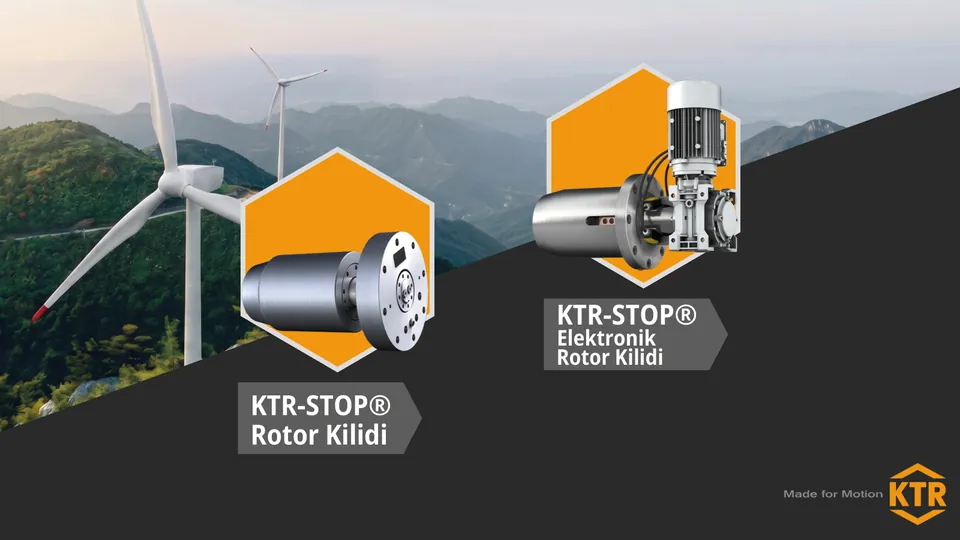
Hydraulic approach: KTR-STOP® RL
In hydraulic locking systems, the pin is moved hydraulically. KTR-STOP® RL represents this approach; the locking function is monitored by sensors.
Electromechanical approach: EMB-STOP® RL
In electromechanical systems, the locking pin is moved electrically. With EMB-STOP® RL, the electrical interface, signal generation via a safety switch and mechanical end-position detection are elements to be assessed during system integration.
Same task, different system architectures
One important point when comparing KTR-STOP® RL and EMB-STOP® RL is that the fundamental purpose of both solutions is the same: mechanically securing the stopped rotor during servicing.
The difference lies in how this function is performed and how it is connected to the turbine’s existing systems.
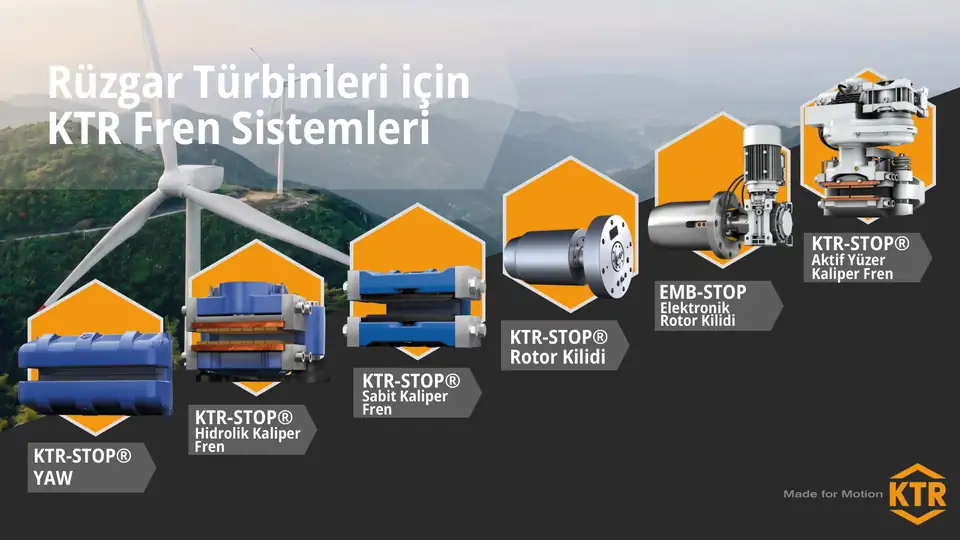
For this reason, selecting a Rotor Lock solely on the basis of the technical values in a product catalogue may not be sufficient to assess the system design as a whole. Whether a hydraulic power unit is available, the electrical control infrastructure, connection and mounting conditions, the turbine’s performance class and the required counter-forces must be considered together.
In other words, there is no single answer to the question “hydraulic or electromechanical?” when selecting a Rotor Lock. The right approach is to determine the operating principle best suited to the turbine’s existing architecture and design requirements.
The starting point for Rotor Lock selection is not a general preference between hydraulic and electromechanical technologies, but defining the mechanical locking function required during maintenance and how this function will be integrated into the turbine system. When transverse force, energy infrastructure, control interface and position monitoring are assessed together, the appropriate locking approach can be determined on the basis of project requirements.
Determining a hydraulic or electromechanical approach is therefore a system design decision that comes before product selection.
Source: KTR Turkey Güç Aktarma Sistemleri

Author
Mesut Kul



 Rüzgar Enerjisi (Wind Energy)Wind Energy Turkey · Ekim 2026 · Özel EkRead the latest issue free →